Storage during renovation is the difference between a contractor who finishes on schedule and one who spends half of every day moving your furniture around. Anyone who has renovated a flat in Tel Aviv or Jerusalem knows the pattern: the kitchen comes out, the living room becomes a warehouse, and three rooms of belongings end up stacked in whichever room is not being worked on that week. The work slows down, the dust gets everywhere, and the family lives in a corridor. Moving the contents out to a locked unit for the duration buys back something hard to price: a site the builders can actually work in.

Contractors price and schedule work on the assumption that they can reach the walls, the floor and the ceiling. In a furnished apartment they cannot. Every stage begins with shifting a wardrobe, laying sheeting and clearing a path, and ends with putting it all back so the family can sleep there. On a kitchen and bathroom renovation that overhead adds up to days, and on a full apartment renovation it can add weeks. Many contractors in Israel quote a lower price for an empty apartment for exactly this reason, and the ones who do not will still finish sooner.
There is a second effect that matters just as much: work done in an empty apartment is simply better work. Floor levelling, plastering and painting all want a clear span and a clean room. When furniture is pushed into the middle and covered, tradespeople work around obstacles and skip the awkward corners. An empty room removes the excuse.
It is rarely the big trades. Demolition, plumbing and electrics are planned, priced and done. The time disappears in the gaps between them, and most of those gaps are caused by the contents of the apartment rather than by the building work itself.
This is the most expensive habit in a staged renovation. A three room apartment renovated room by room means the same sofa, wardrobe and bed get carried four or five times before the job ends. Each move takes two people, risks a scratched floor or a torn upholstery panel, and happens on your time rather than the builder’s.
Construction dust in Israel is mostly pulverised plaster, cement and stone, and it is far finer than household dust. It travels through closed doors, settles inside sealed cupboards and works its way into fabric, electronics and bedding. Plastic sheeting slows it down but does not stop it, because the sheeting gets lifted a hundred times over the course of the work. Anything left on a renovation site will need deep cleaning afterwards, and some of it will not recover.
Upholstery, mattresses, rugs and curtains are the worst affected, because fine grit sits deep in the fibres where a vacuum cannot reach it. The grit then acts as an abrasive every time someone sits down, which is why a sofa that spent a renovation under sheeting often looks years older afterwards. Professional cleaning for a sofa, a mattress and two rugs typically costs more than several months of a small storage unit.

In Tel Aviv the apartment is usually not the problem. The street is. Many of the flats being renovated are in walk-up buildings from the 1930s to the 1960s with no lift, narrow stairwells and tight turns on the landings. Parking a van outside for an hour needs planning, and the municipality is strict about skips and loading on the pavement. All of that argues for one single removal at the start of the job rather than repeated trips.
Two of our branches serve the city, Florentin and Kibbutz Galuyot Road, so the drive from a renovation site in central or southern Tel Aviv is short. If you are weighing up what to do with a whole apartment’s contents, the detail on storing an apartment in Tel Aviv covers how people split what travels from what stays.
Jerusalem renovations tend to run longer than their Tel Aviv equivalents. Stone construction means more demolition dust, older buildings throw up more surprises behind the walls, and permits in the historic neighbourhoods take their own time. A renovation planned for three months quite often lands at five, and that gap is exactly where storage earns its keep.
The branch serving the whole Jerusalem area is Kiryat Anavim, at the Route 1 interchange just west of the city, about 16 minutes from the city centre and about 9 minutes from Givat Shaul without traffic. The guidance on apartment content storage in Jerusalem sets out what a full apartment’s contents actually needs.
You do not need to empty the apartment completely for every job. The rule of thumb is to move out anything that dust ruins, anything the trades will have to carry, and anything you will not use before the work ends.
What stays is the short list: the contractor’s tools and materials, a few kitchen basics and one set of bedding per person.
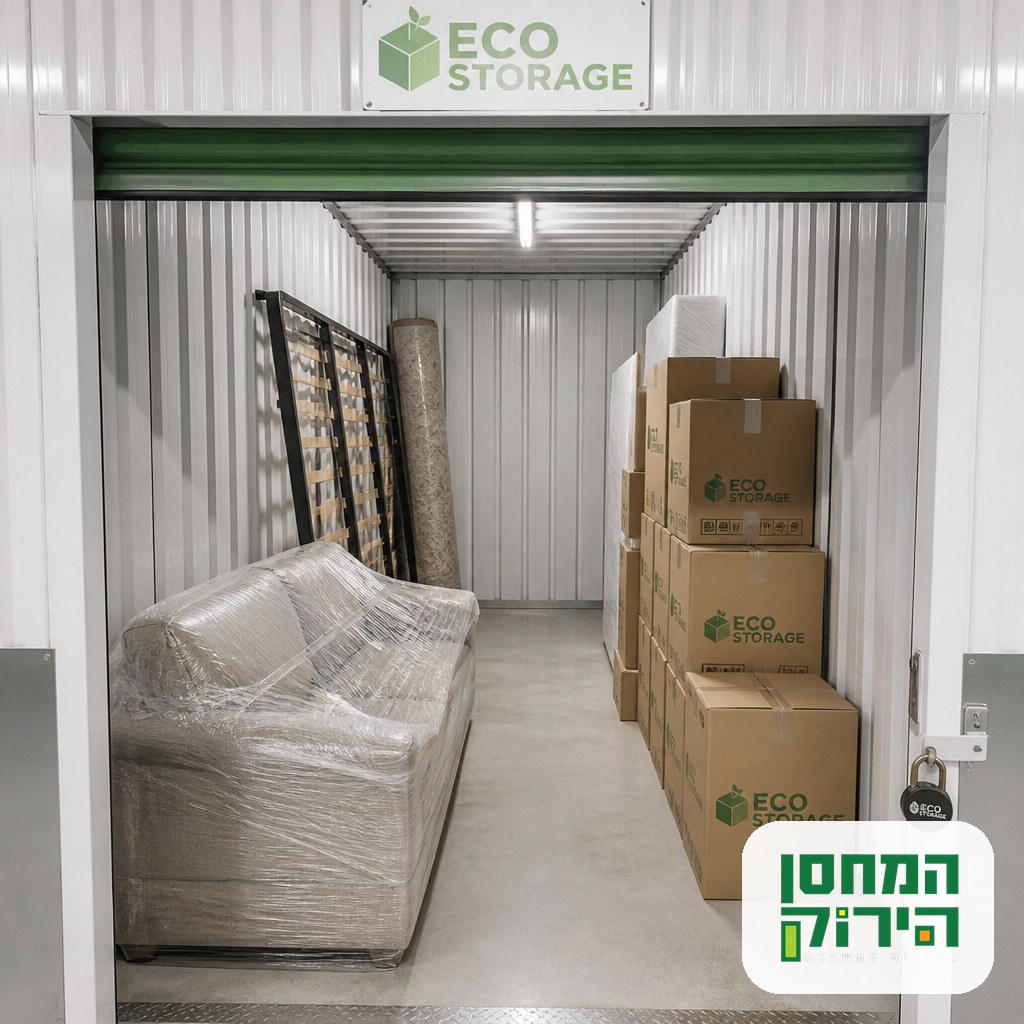
The size you need depends on how much of the apartment is being worked on, not on the size of the apartment itself. A kitchen and bathroom refit needs far less space than a full strip out, even in the same flat. As a rough translation:
Two things shrink the unit you actually need. Dismantling is the first: a bed and a flat-pack wardrobe taken apart occupy roughly a third of their assembled volume. Stacking to the ceiling in same-size boxes is the second. Once you have a list of the large items, comparing it against the published unit sizes is quicker than guessing, and it is worth doing before you book the contractor rather than after.
On duration, be realistic. Renovations in Israel overrun more often than they finish early, so plan for the quoted timeline plus a margin. There are three commitment tracks, no commitment, six months to a year, and over a year, and the monthly rate is lowest on the over-a-year track. For a renovation most people want the flexibility of a short track, and that is usually the right call.
Packing for a renovation differs from packing for a move, because you will almost certainly go back into the unit mid-job for a document, a tool or a change of season clothing. That one fact changes how you pack.
If you are short of materials, the boxes, tape and protective wrap in our packing supplies shop are the same ones used on apartment moves, and a few spare boxes cost less than repacking a torn one.
A renovation goes quickest when the trades have clear rooms, and your belongings last longest when they spend the work somewhere dry, closed and dust-free rather than under sheeting in the next room. Measure what has to come out, dismantle what you can, pack it so you can find it again, and book the unit for the real timeline rather than the optimistic one. Contact Green Storage to work out the unit size that fits your renovation and the branch easiest to reach from the site, and it is worth checking the current price list for storage units while you plan the move out.
Plan for the contractor’s quoted timeline plus a margin of at least a month, and longer in Jerusalem where older buildings and permits stretch the schedule. Most renovation customers take a unit for three to six months, on the no-commitment or six-month track, and extend if the work runs on.
Usually, yes. Many contractors quote less for an empty flat because they lose no time shifting and re-covering furniture, and the ones who quote the same still finish sooner. Set the unit cost against the days saved plus the deep cleaning you avoid, and for most full renovations the storage pays for itself.
Yes, and it is worth packing on that assumption. Florentin in Tel Aviv, Kiryat Anavim near Jerusalem and Kibbutz Yakum in the Sharon are open for access during branch opening hours, and the Kibbutz Galuyot Road branch in Tel Aviv offers 24/7 access to the units. The unit is closed with your own personal lock.
Contents insurance is not part of the rental price. It is bought as an add-on covering the full declared value of what you store, at a rate of ₪1.8 per ₪1,000 of declared value, and the cover is comprehensive and includes earthquakes. Declare a realistic value rather than a low one, especially when a whole apartment’s furniture and appliances are in the unit.
Units sit inside a closed building, raised off the floor, and close with your own lock, and every branch has closed-circuit cameras and alarm systems connected to a security and patrol dispatch centre. Belongings packed properly come back in the condition they went in, unlike furniture that spent the renovation under sheeting on site.
Fresh or perishable food, flammable and hazardous materials, gas, fuel, plants and animals. This matters more than usual during a renovation, because paint thinners, adhesives, solvents and gas canisters turn up while clearing the flat. Those stay with the contractor or go to proper disposal.

How can we help you today?